


Syllabus: GS3/ Energy
Context
- The SHANTI (Sustainable Harnessing of Advancement of Nuclear Technology for India) Act 2025, have triggered concerns regarding safety standards, victim compensation, and long-term energy strategy.
About
- Traditionally, nuclear power plants in India have been owned and operated only by state-owned Nuclear Power Corporation of India Ltd (NPCIL) and its fully-owned subsidiary Bharatiya Nabhikiya Vidyut Nigam (BHAVINI).
- The SHANTI Act opens the nuclear power sector to private entities and alters the liability framework under the Civil Liability for Nuclear Damage Act (CLNDA), 2010.
Key provisions of the SHANTI Act
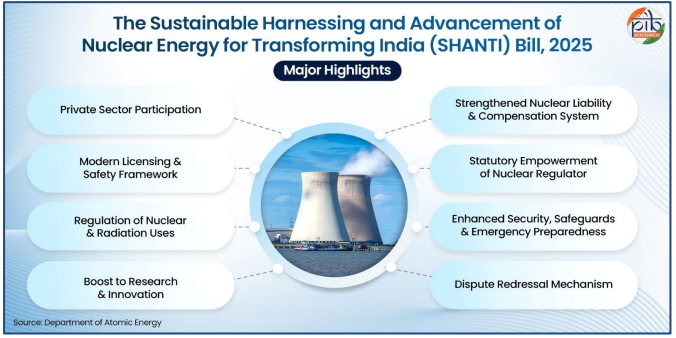
- Revamp of the Nuclear Liability Regime: The Act indemnifies nuclear suppliers by channeling liability for any accident to the operator. It omits the “right of recourse” that allows operators to sue suppliers for accidents caused by defective equipment.
- The Act also omits Clause 46 of the CLNDA, which allowed victims to invoke other laws, including criminal laws, to seek remedies.
- The Act provides a legislative framework for the Atomic Energy Regulatory Board but limits the Board’s independence by stipulating that its members will be selected by a committee constituted by the Atomic Energy Commission.
- Exemption for Certain Activities: Allows exemption from a license for limited activities like research, development, and innovation-related work.
- Regulation of Non-Power Applications: Provides a regulatory framework for the use of nuclear and radiation technologies in health care, agriculture, industry, research, and other peaceful applications.
Concerns raised over SHANTI Act
- The indemnification of suppliers is one of the most contentious aspects of the Act.
- The Fukushima Daiichi nuclear disaster exposed weaknesses in reactor containment design and emergency preparedness.
- The Chernobyl disaster involved structural design flaws, including a positive power coefficient and inadequate emergency shutdown systems.
- The Three Mile Island accident revealed significant control room design failures and communication lapses by suppliers.
- Issue of Moral Hazard: Protecting agents from the consequences of their actions creates a “moral hazard” and encourages them to take greater risks.
- The Act indemnifies operators for accidents caused by “a grave natural disaster”, reversing India’s “absolute liability” framework for hazardous industries. This reduces the industry’s incentive to establish resilient plants.
Way Ahead
- Enhance transparency and public consultation in site selection, environmental clearance, and safety audits to build community trust and reduce project delays.
- Build climate-resilient nuclear infrastructure by mandating higher safety benchmarks against extreme natural disasters, especially in light of lessons from the Fukushima Daiichi nuclear disaster.
- Establish a robust nuclear insurance pool with adequate sovereign backing to ensure swift and fair compensation in case of accidents.
Source: TH
Previous article
Indian IT Sector at a Crossroads Amid ‘SaaSpocalypse’ Fears
Next article
News In Short 13-02-2026
